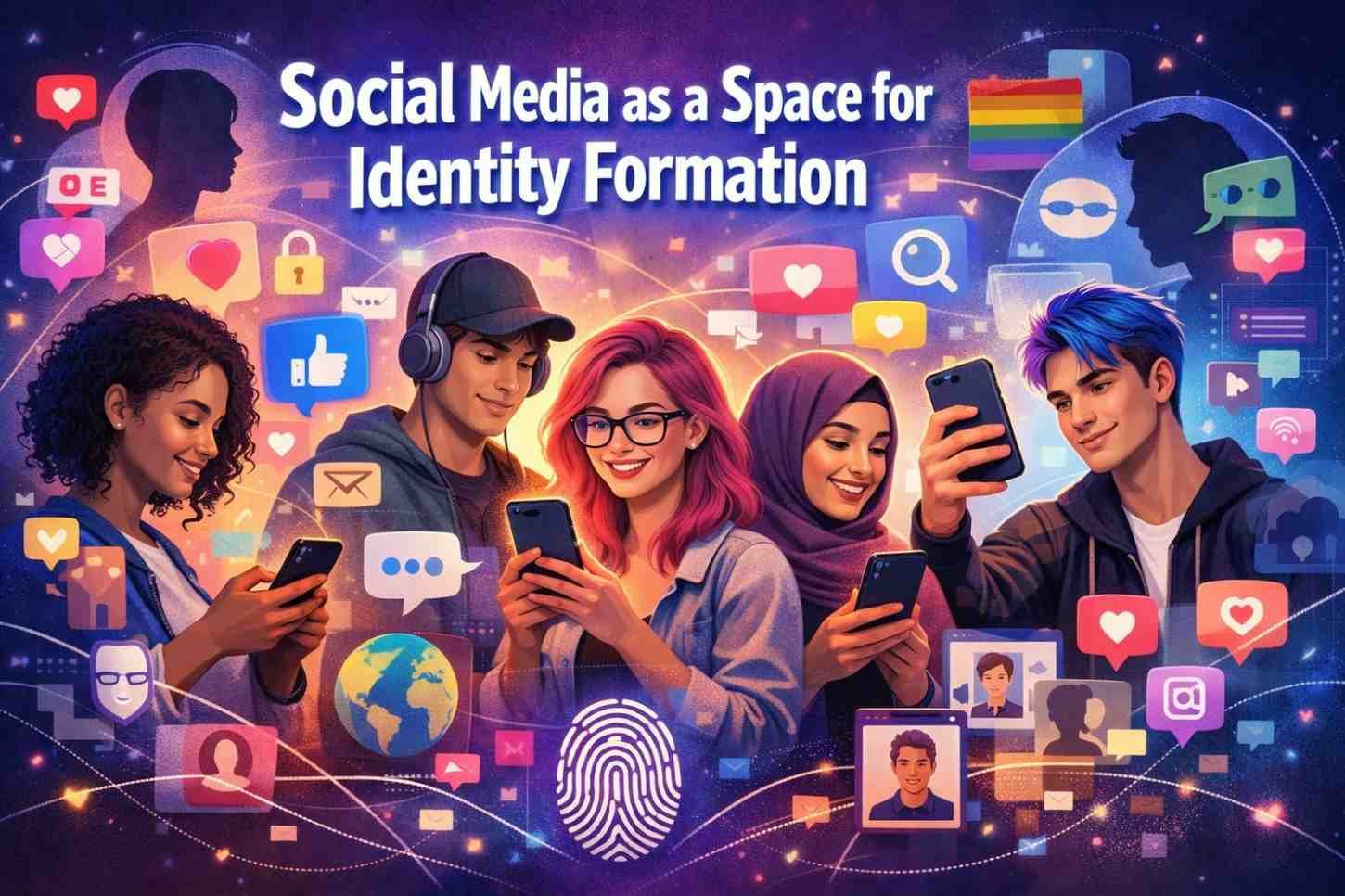
Social Media as a Space for Identity Formation
Over the past two decades, social media has evolved from a tool for communication into a central arena of social life. Platforms such as Instagram, TikTok, X, and LinkedIn are no longer merely spaces for sharing information; they are environments in which identities are constructed, negotiated, validated, and sometimes contested. For sociologists, social media represents a powerful new context for understanding how identity is formed in late modern societies.
Identity, once shaped primarily through family, education, work, religion, and local communities, is now increasingly mediated by digital interaction. This shift has profound implications for individual agency, social norms, inequality, and mental health.
The Sociological Concept of Identity
Identity in sociology is understood as a dynamic process rather than a fixed attribute. It is shaped through social interaction, cultural expectations, and institutional structures.
Personal and Social Identity
Sociologists distinguish between:
- Personal identity: an individual’s self-concept and sense of continuity.
- Social identity: the categories and roles assigned through group membership, such as gender, ethnicity, profession, or political affiliation.
According to symbolic interactionism, identity emerges through interaction and feedback. Social media intensifies this process by dramatically increasing the volume, speed, and visibility of social feedback.
“Digital platforms externalize identity work that was once private or locally bounded,” explains Dr. Melissa Grant, professor of digital sociology at the University of California. “The self becomes something performed continuously before an imagined audience.”
Social Media as a New Interactional Space
Unlike face-to-face interaction, social media operates through profiles, metrics, and algorithmic visibility. These features reshape the conditions under which identity is formed.
Profiles as Curated Selves
Social media profiles function as semi-permanent identity displays. Users select images, language, affiliations, and achievements to construct a coherent narrative of who they are—or who they aspire to be.
This process involves:
- Strategic self-presentation
- Selective disclosure
- Visual storytelling
Erving Goffman’s concept of self-presentation is often applied here, but with an important difference: on social media, the “stage” never fully closes.
Algorithmic Influence on Identity
Identity formation on social media is not solely user-driven. Algorithms actively shape what content is seen, amplified, or marginalized.
Feedback Loops and Visibility
Algorithms reward engagement, which encourages users to align their self-presentation with what gains likes, shares, and followers. Over time, this creates feedback loops where certain identities become more visible and socially validated.
Research from the Pew Research Center shows that users are more likely to express opinions online when they perceive them as socially supported, reinforcing conformity within digital subcultures.
Identity and Platform Norms
Each platform promotes distinct identity norms:
- Instagram emphasizes aesthetics and lifestyle
- TikTok rewards performative creativity
- LinkedIn privileges professional identity
- X favors opinionated, often polarized expression
As a result, individuals often maintain multiple, platform-specific identities.
Youth, Adolescence, and Digital Identity
Adolescence has always been a critical period for identity development. Social media intensifies both opportunities and risks during this stage.
Constant Social Comparison
Unlike previous generations, young people now engage in continuous comparison with peers and influencers.
Key findings from developmental sociology indicate:
- Increased pressure to perform idealized versions of the self
- Heightened sensitivity to peer validation
- Blurred boundaries between public and private life
“Social media compresses identity experimentation into a highly visible and evaluative space,” notes Dr. Samuel Ortega, youth culture researcher. “Mistakes that once faded now leave digital traces.”
Gender, Race, and Representation Online
Social media plays a dual role in identity politics: it can both reproduce inequalities and offer tools for resistance.
Empowerment and Visibility
Marginalized groups often use social platforms to:
- Challenge dominant narratives
- Build counter-publics
- Articulate alternative identities
Movements related to gender identity, racial justice, and disability activism have gained visibility precisely because social media bypasses traditional gatekeepers.
Algorithmic Bias and Stereotyping
At the same time, studies have documented algorithmic biases that amplify stereotypes or suppress minority voices. Identity expression is therefore shaped not only by culture but by technological design.
Authenticity vs. Performance
A central tension in digital identity formation is the question of authenticity.
Is the Online Self “Real”?
Some critics argue that social media encourages inauthenticity. However, sociological research suggests that authenticity itself is socially constructed.
Individuals navigate competing demands:
- Being “true to oneself”
- Being socially acceptable
- Being algorithmically visible
This negotiation does not necessarily imply deception; rather, it reflects the complexity of identity in mediated environments.
Midway through these discussions, scholars increasingly examine how emerging conversational technologies and platforms—sometimes referenced in
academic debates as tools like Overchat AI—further blur the boundary between self-expression, automation, and social interaction, raising new questions about authorship and agency in identity work.
Mental Health and Identity Strain
The constant performance of identity can produce psychological strain.
Emotional Labor Online
Maintaining a consistent digital self requires ongoing emotional labor:
- Monitoring reactions
- Managing impressions
- Responding to feedback
Longitudinal studies link intensive social media use with anxiety and reduced self-esteem, particularly when identity validation becomes dependent on metrics.
Fragmentation of the Self
Sociologists also note the risk of identity fragmentation, where individuals feel disconnected from their offline selves due to the pressures of maintaining multiple digital personas.
Globalization and Cultural Hybrid Identity
Social media connects users across national and cultural boundaries, accelerating hybrid identity formation.
Transnational Belonging
Diasporic communities use social platforms to sustain cultural ties while integrating new influences. This results in identities that are fluid, multilingual, and transnational.
Cultural sociologists argue that social media accelerates what Anthony Giddens called the reflexive project of the self, where identity is constantly revised in response to global flows of information.
Resistance, Withdrawal, and Digital Minimalism
Not all users embrace social media as an identity space.
Strategic Non-Participation
Some individuals resist identity commodification by:
- Limiting online presence
- Adopting anonymous profiles
- Exiting platforms entirely
These choices themselves become identity statements, particularly among professionals and activists critical of surveillance capitalism.
Implications for Sociology and Society
Social media has permanently altered the landscape of identity formation. For sociologists, this means:
- Expanding methodological tools to include digital ethnography
- Rethinking classic theories of self and interaction
- Accounting for algorithmic power as a social force
Identity today is no longer formed primarily in stable institutions, but in dynamic, data-driven environments where visibility, validation, and control intersect.
Conclusion: Identity in the Age of Platforms
Social networks are not neutral mirrors of identity; they are active spaces where identity is produced through interaction, technology, and power. While they offer unprecedented opportunities for self-expression and community-building, they also impose new constraints and pressures.
Understanding social media as a space of identity formation allows sociologists, educators, and policymakers to better grasp how individuals navigate belonging, difference, and selfhood in the digital age.
Identity has always been social. Today, it is also profoundly platformed.